
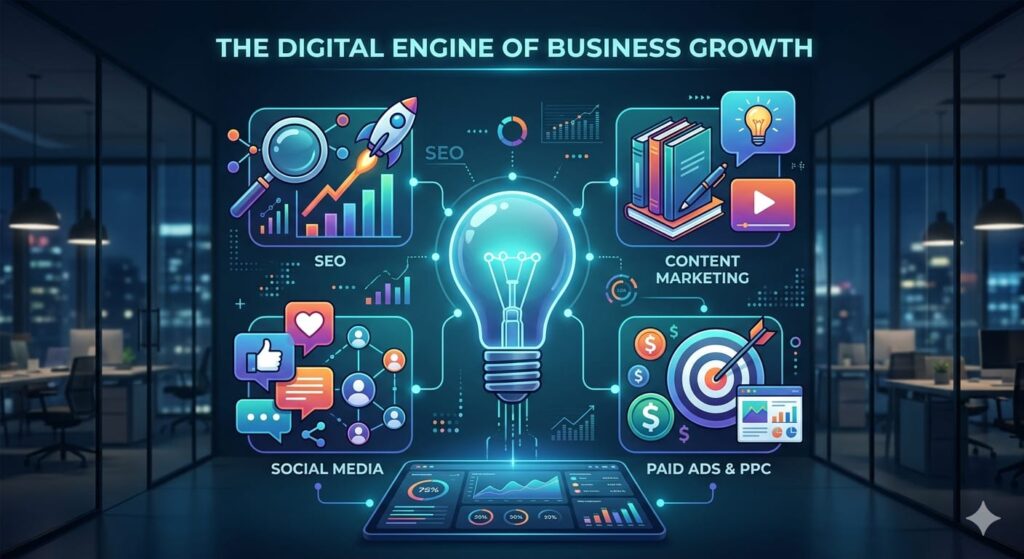
In today’s hyper-connected world, the question for business owners is no longer if they should invest in digital marketing, but how fast they can adapt to it. The shift from traditional storefronts to digital landscapes has transformed how consumers discover, interact with, and purchase from brands.
If you aren’t visible on the screens your customers are looking at every day, you simply don’t exist to a vast portion of your market. Here is a breakdown of the core pillars of digital marketing and why they are essential for your business success.
1. Search Engine Optimization (SEO): The Long-Term Asset
SEO is the process of optimizing your website so that it ranks higher on search engine results pages (SERPs) like Google.
Why it matters: Unlike paid ads that stop working the moment you stop paying, SEO builds “organic equity.”
The Result: When someone searches for a solution you provide, you appear as a trusted authority right at the top.
2. Content Marketing: Building Authority and Trust
Modern consumers are allergic to “hard selling.” They want value. Content marketing involves creating helpful blog posts, videos, and infographics that solve customer problems.
The Strategy: Don’t just sell products; sell expertise. By educating your audience, you build a bridge of trust that makes the eventual sale feel natural rather than forced.
3. Social Media Marketing: Where the Conversation Happens
Social media platforms like Instagram, LinkedIn, and Facebook are no longer just for personal updates; they are powerful customer service and discovery tools.
Engagement: It allows for two-way communication. You can get real-time feedback, run polls, and humanize your brand through behind-the-scenes content and stories.
4. Pay-Per-Click (PPC) Advertising: Speed to Market
While SEO is a marathon, PPC (Google Ads or Meta Ads) is a sprint. It allows you to place your brand in front of a highly targeted audience almost instantly.
Precision: You can target users based on their specific location, age, interests, and even their past browsing behavior, ensuring your budget is spent on high-intent leads.
5. Data Analytics: The Power of Measurement
The greatest advantage of digital marketing over traditional methods is measurability. With tools like Google Analytics, you no longer have to guess what’s working.
Optimization: You can track exactly how many people clicked your ad, how long they stayed on your site, and what caused them to leave. This data allows you to pivot and refine your strategy for maximum ROI.
Conclusion: The Path Forward
Digital marketing is not a “one-and-done” task; it is a continuous cycle of reaching, engaging, and converting your audience. By integrating these strategies, you create a digital ecosystem that works for you 24/7, even while you sleep.
Ready to scale your digital presence?
Whether you are starting from scratch or looking to optimize your existing strategy, our team is here to help you navigate the digital landscape.
[Contact Us Today for a Free Strategy Consultation]
Quick Tips for Posting:
Use High-Quality Visuals: Break up the text with professional images or infographics.
Internal Linking: Link this blog to your “Services” page to keep readers on your site.
Mobile Friendly: Ensure your website’s layout is responsive, as most readers will access this via smartphone.
Would you like me to suggest a few SEO-friendly meta descriptions or social media captions to go along with this post?